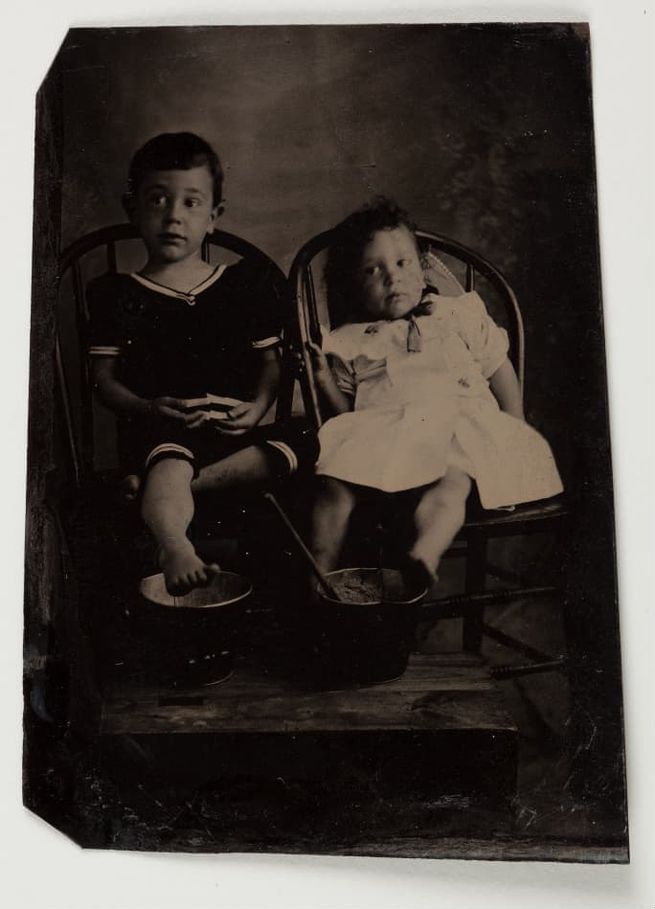
1856-1920, undated, predominant 1865-1900
HAV-01-403
GUSN-325646
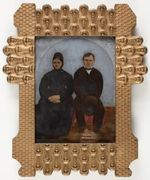
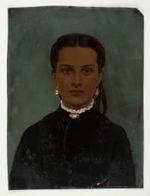
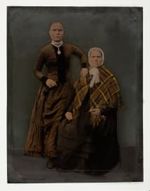
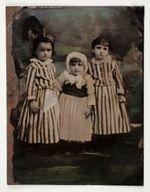
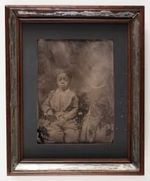
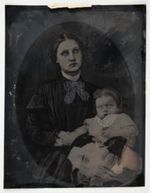
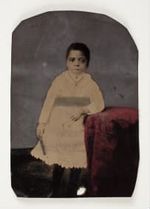
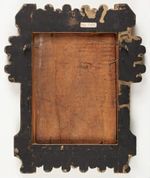
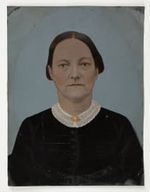
This collection consists of over five hundred tintype portraits purchased by Dr. Diana Korzenik at flea markets in New England. It contains over two hundred large (whole plate or mammoth) tintypes (Series I-IV, VIII). Most of these are loose plates. Over 40 are framed or mounted, although not all frames are original to the tintypes. Nearly all larger tintypes have been painted, tinted, outlined, scratched, and/or treated by chemical coloring processes. Some of these larger tintypes are copies of smaller tintypes or other photographic forms, as is typical of painted tintype portraits. Not all copies have been identified. There are a few pairs of the same photographic image, illustrating the various ways a photograph was colored and manipulated. Painted portraits also exhibit a range of painting skill. There are at least four trademark tintypes in this collection: three Electrographs and one Pennellograph. Nearly all painted portrait subjects are unidentified, although some tintypes contain semi-legible words or numbers which are painted or scratched on the plate.
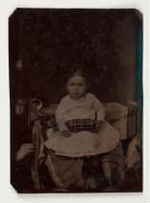
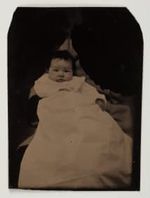
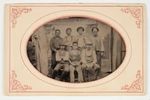
This collection also contains about three hundred small tintypes (Series V, VI, and VII). Nearly all of these can be considered bon-ton tintypes, ranging from roughly 2½ x 3½ to 4 x 5¾ inches. There are very few gem-size tintypes (which measure about one square inch). The small tintypes are mostly studio portraits, and most portrait subjects are unidentified men, women, and children who appear to be middle or working class. There are a few outdoor tintypes, but the majority contain studio painted backdrops and props. Unlike many of the larger tintype portraits, the smaller tintypes show people posing casually, with dogs, and in large groups. None of the smaller tintypes contain overpainted backgrounds. Color is restricted to tinted cheeks and painted jewelry and accessories. There are also roughly two hundred images of young children, most with the detectable but hidden presence of an adult (Series VII).
tintypes (prints)
tintype (process)
photographs
portraits
women (female humans)
children (people by age group)
props (object genres)
tintypes (prints)
Collection of over five hundred painted and unpainted tintype photographs.
An electronic finding aid is available through Historic New England's Collections Access Portal. A paper finding aid is available in the Library & Archives.
This collection was created by artist, arts educator, and author Dr. Diana Korzenik. Dr. Korzenik purchased the tintypes at New England flea markets over many years.
PC068
The Diana Korzenik Collection of Painted Tintypes
2014
PC068
This collection contains over five hundred painted and unpainted tintype portraits of various sizes.
Boston (Suffolk county, Massachusetts)
New York City (New York state)
Korzenik, Diana
tintypes (prints)
Photograph
Portrait
Women
Children
This collection is available for research.
Series VIII, Framed tintypes, is held at Historic New England's Haverhill facility. There are no technical restrictions on this collection.
Collection
HAV-01-403
Accruals are not expected.
All markings on photographic mounts, sleeves, and plates are in English.
[Item identification.] Folder #. Diana Korzenik Collection of Painted Tintypes (PC068). Historic New England, Library & Archives.
This collection was processed by Historic New England intern Caroline Littlewood in July 2017.
The tintype was invented in 1856 by Hamilton L. Smith. It became popular during the Civil War and remained in use into the first decades of the twentieth century. Like its immediate predecessor, the ambrotype, the tintype was formed by the wet-plate collodion process. To produce a wet-plate collodion image, a photographer would treat a photographic plate with a collodion emulsion (a combination of gun cotton, ether, and alcohol) and various chemical solutions before placing it, still wet, into a frame within the camera. The exposure lasted roughly six to ten seconds, then the photographer removed the plate. Finally, he bathed it in chemicals again to develop and fix the image, and dried it under heat.
The final product was a direct positive image and a lateral reversal of the photographer's view of the subject. And while ambrotypes used glass plates that could be flipped to closer reflect reality, tintypes were made of metal plates and the image could only be flipped with the use of a reversal lens in the camera or by taking another tintype of the original. Since the wet-plate collodion process didn't produce replicable negatives, tintypes were made one at a time or by employing multiple lenses.
i720 The tintype photographic process was fast and relatively easy. Customers could have their picture taken and leave with an image within the hour. Made of light and durable sheet iron, the tintype traveled well in the mail. During the Civil War, itinerant tintype photographers followed the Union troops, producing portraits for soldiers to send home to loved ones. Even after the war, many tintype photographers continued to travel from town to town, serving rural areas and small villages rather than set up permanent studios. The tintype was also more affordable than the earlier daguerreotype. For the first time, large numbers of immigrants, laborers, and people of color could record and preserve their likenesses. Under-documented and minority populations become a part of the photographic record and a budding American photographic tradition.
In the early days of photography, people applied paint to photographs to resemble the painted portraits with which they were already familiar. Of all early photographic forms, the tintype was the most frequently overpainted. It was a cheap alternative to an original painting, a way for the average working American to have a painted likeness and all the pride and respectability traditional painted portraiture represented. Some painters-or colorists-sought to replicate the look and feel of a crisp and colorful painting by covering a tintype's photographic origins. Paint could also hide undesirable features or cover over an unglamorous studio setting. Other colorists used less paint, intending to touch up a low-contrast copy image or add definition.
In addition to painting over the emulsion, colorists outlined, etched, and tinted the tintype plate. Different methods cost different amounts. Some people could only afford the cheapest enhancement, like a little powder to color the cheeks or some gold paint over the portrait subject's jewelry. For a little more money, colorists used primary colors to subtly tint an image, or India ink to outline and define the subject's features. They painted the clothing or lined the eyes, but frequently left other features, like the ears or hands, unpainted. These were much harder for a colorist to enhance and more paint cost the customer more money.
Overpainted tintype portraiture maintained popularity into the 1890s. The tintype, as a photographic form, survived even later. Well into the twentieth century, the tintype booth was a feature of carnivals and amusement sites across America. Ultimately, the tintype was never the most popular form of photograph. Nevertheless, it documented the lives of American people for roughly seven decades, longer than nearly any other photographic form.
Burns, S. B. (1995). Forgotten Marriage: The Painted Tintype & The Decorative Frame, 1860-1910: A \n Lost Chapter in American Portraiture. New York, NY: Burns Press.\n Henisch, H.K and Henisch, B. A. (1996). The Painted Photograph, 1839-1914: Origins, Techniques, \n i720Aspirations. University Park, PA: Penn State University Press.\n Kasher, S. (2008). America and the Tintype. New York, NY: International Center of Photography.\n Korzenik, D. (2016). Anna Mary Robertson Moses: Rethinking Self-Taught. In Grandma Moses: \n i720American Modern (pp. 45-72). New York, NY: Skira Rizzoli.\n Pfeiffer, C. (2012). A Descriptive Analysis of Ten Painted Tintypes from the George Eastman House \n i720Collection (Thesis). Ryerson University, Toronto, Ontario, Canada.\n Rinhart, F. and Rinhart, M. (1990). The American Tintype. Columbus, OH: Ohio State University Press.\n Schimmelman, J. G. (2007). The Tintype in America, 1856-1880. Philadelphia, PA: American \n i720Philosophical Society.\n Taft, R. (1938). Photography and the American Scene: A Social History, 1839-1889. New York, NY: \n i720Dover Publications, Inc.\n Trachtenberg, A. (1989). Reading American Photographs: Images as History, Mathew Brady to Walker \n i720Evans. New York, NY: Hill and Wang. \n Welling, W. (1978). Photography in America: The Formative Years, 1839-1900. New York, NY: Thomas \n i720Y. Crowell Company.
Andrew S. Dibner collection of tintypes. Harvard Art Museums/Fogg Museum, Cambridge, Massachusetts.
Diana Korzenik Collection of Art Education Ephemera. Huntington Library, San Marino, California.
Julia Driver Collection of Women in Photography (GEN MSS 690). Beinecke Rare Book and Manuscript Library, Yale University, New Haven, Connecticut.
Tintype portraits [graphic]. Photography Collection, New York Public Library.
i-360\li720Peter E. Palmquist collection of photography and photographic formats (WA Photos 495). Yale Collection of Western Americana, Beinecke Rare Book and Manuscript Library.
The Diana Korzenik Collection of Painted Tintypes was accessioned as a whole collection. It retains original order down to the item level, with a few exceptions noted in the series level scope and content notes. Series distinctions were established by the donor over years of investigative collecting. They reflect her interest in the tintype portrait as a product of both painter and photographer and her desire to preserve a visual record of under-documented populations.
The collection is arranged in eight series, which are arranged as follows:
Series I. Transparent faces
Series II. Hand-painted tintypes powder/gold jewelry/white lines/black lines
Series III. Children and couples
Series IV. Thick paint, white lines, black lines
Series V. Black and white larger/cabinet card size
Series VI. Black and white carte de visite-sized
Series VII. Hidden mothers
Subseries A. Scratched, blacked-out, and painted faces
Subseries B. Visible faces
Subseries C. Visible hands or bodies
Subseries D. Drapery, blankets, and textiles
Subseries E. Visible restraints
Subseries F. Siblings
Subseries G. Sleeves or mounts
Series VIII. Framed tintypes
Historic New England is committed to implementing reparative language description for existing collections and creating respectful and inclusive language description for new collections. If you encounter language in Historic England's Collections Access Portal that is harmful or offensive, or you find materials that would benefit from a content warning, please contact [email protected].
Sign up to our newsletter for our latest news and events

 Loading...