Geo.: Large: Mass.: Boston: Smith Court: Unmounted
GUSN-196113
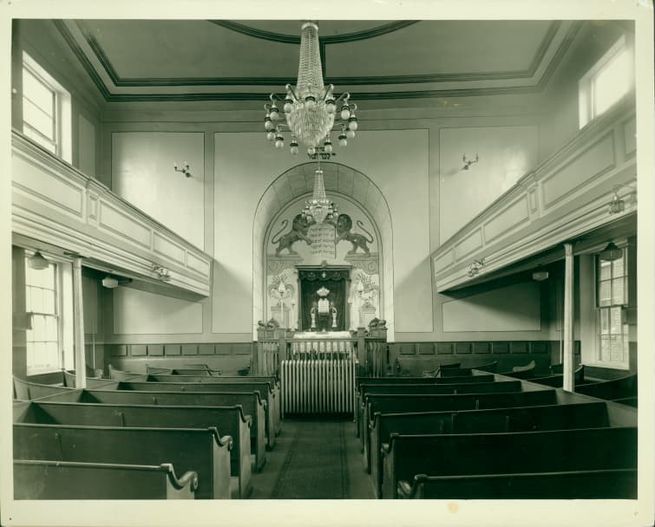
The pulpit, pews and balcony seats are shown in this image of the African Meeting House, located on Smith Court on Beacon Hill in Boston. The Meeting House was built in 1806 and is the oldest African meeting house in the United States. The building was built with funds raised by local Black and white community members, but was constructed almost entirely with Black labor.
At the time of this photograph, the African Meeting House had become the home of Congregation Libavitz. Though the pews in the photograph are the original pews, the pulpit was no longer original to the building. "At the end of the 19th century, when the Black community began to migrate from the West End to the South End and Roxbury, the building was sold to a Jewish congregation. It served as a synagogue until it was acquired by the Museum of African American History in 1972" (Museum of African American History website). For more information, see Old Time New England July 1942, v.33, no. 1, serial no. 109.
interior views
religious buildings
churches (buildings)
meeting houses (religious buildings)
synagogues (buildings)
pews
bemas
photographs
black-and-white prints (photographs)
DigitalID 001140
AccessID 1540
Other identifier HNEDID-001140
1 photographic print : black-and-white
PC001
General photographic collection
PC001.02.01.USMA.0340.7300.003
Boston (Suffolk county, Massachusetts)
Beacon Hill (Boston, Suffolk county, Massachusetts) [neighborhood]
Haskell, Arthur C. (Arthur Cushman), 1890-1968 (Photographer)
photographs
black-and-white prints (photographs)
Congregation Libavitz
Architectural photography
African Americans
Joy Street (Boston, Mass.)
Black People
Item
Geo.: Large: Mass.: Boston: Smith Court: Unmounted
Historic New England is committed to implementing reparative language description for existing collections and creating respectful and inclusive language description for new collections. If you encounter language in Historic England's Collections Access Portal that is harmful or offensive, or you find materials that would benefit from a content warning, please contact [email protected].
Sign up to our newsletter for our latest news and events

 Loading...