
The experience of moving through a historic house is central to how visitors understand the people and histories connected to these spaces. But architectural features that help preserve this sense of authenticity can also create obstacles for visitors with disabilities. As historic sites work to serve broader and more diverse audiences, accessibility has become an increasingly important consideration in preservation practice. At Historic New England, we believe accessibility and preservation can and should work together, even though balancing these goals is rarely straightforward in buildings that predate modern accessibility standards by centuries.
To help address these challenges, Historic New England is introducing an Accessibility series as part of our Property Care White Papers. Accessibility white papers are intended to support preservation professionals, museum practitioners, architects, and advocates working at the intersection of historic preservation and inclusive design. Each paper explores practical strategies for improving access in historic house museums while carefully considering the impact of interventions on historic fabric and character-defining features.
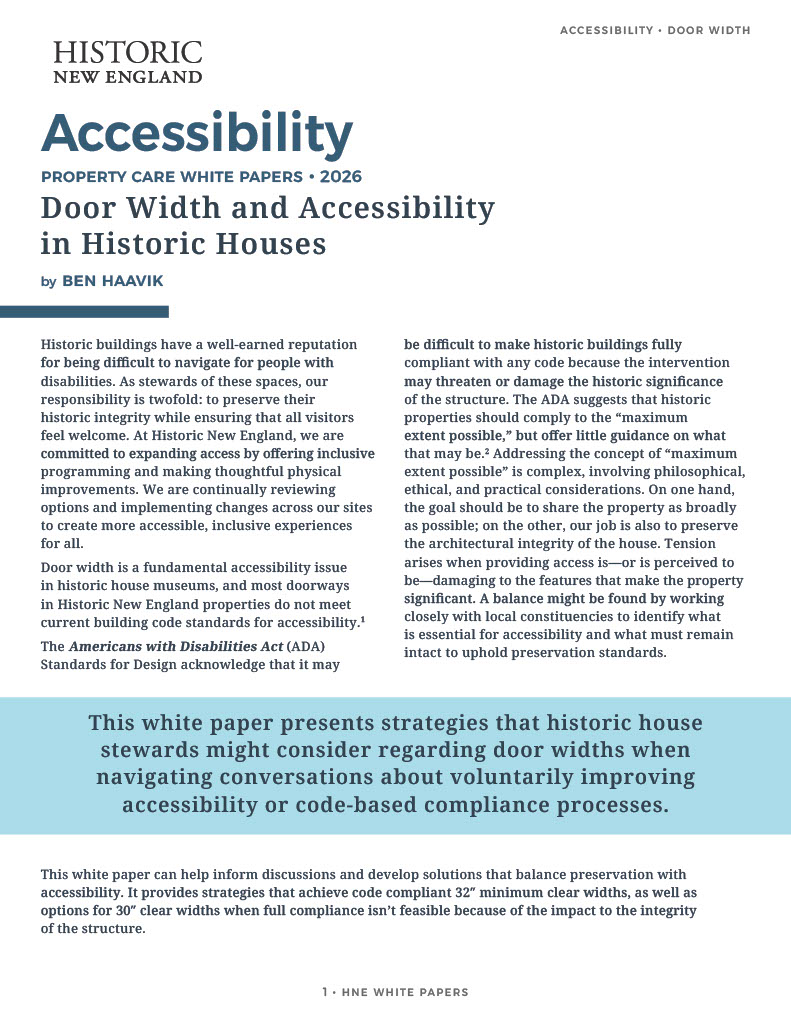
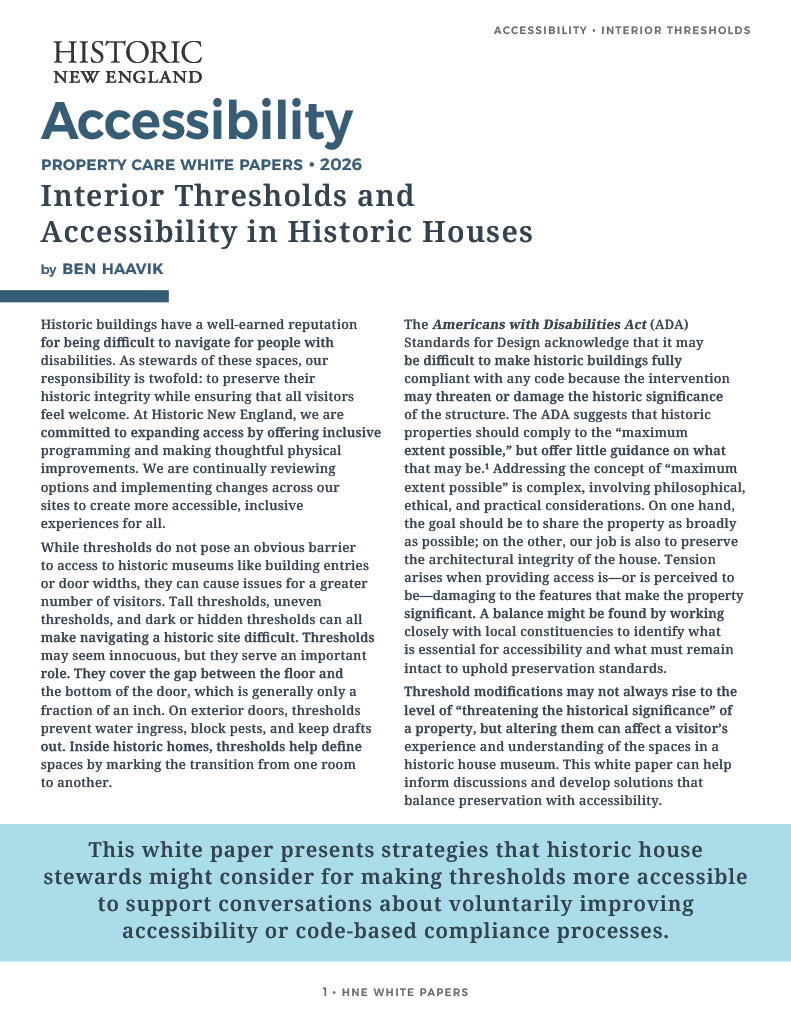
The first two papers in the series are now available and focus on common, but complex, issues in historic interiors: door widths and interior thresholds. At the heart of the white papers is Historic New England’s broader philosophy regarding accessibility and preservation. When evaluating potential interventions, we consider four central questions: What is the public benefit of the change? How much historic fabric will be affected? Will the intervention alter character-defining features or the spatial experience of the building? And can the intervention be reversed in the future?
The door width white paper examines one of the most persistent accessibility challenges in historic houses. Most historic homes do not meet current ADA clear-width standards, and modifying door openings can require interventions that affect historic trim, plaster, framing, flooring, and circulation patterns. The white paper explores tensions preservation organizations may encounter when attempting to improve accessibility without compromising the spatial qualities and material integrity that make their buildings significant. It presents a range of potential strategies, including approaches that achieve the ADA’s 32-inch minimum clear width, as well as alternative solutions that provide improved access when full compliance would result in disproportionate impacts to the structure.
The interior thresholds white paper focuses on another architectural feature that can create substantial barriers for visitors with mobility, balance, or vision impairments. Raised or uneven thresholds may impede wheelchair movement, create tripping hazards, or make transitions between spaces more difficult to perceive. At the same time, thresholds serve important functional and interpretive purposes within historic homes. They help protect against drafts and moisture, conceal construction gaps, and reinforce the progression between rooms. The white paper examines ways to mitigate accessibility barriers while preserving the experiential and architectural qualities of historic interiors. It also considers how relatively modest interventions can alter visitors’ understanding of a historic space.
Historic New England’s accessibility white papers series reflects an ongoing commitment to approaching preservation and access as complementary objectives rather than competing priorities. We also believe meaningful access is best achieved through dialogue with the communities affected by proposed changes, which can help identify both the features that are essential to preserve and the improvements that are most critical for equitable access. We thank Open Door Arts for their thoughtful review and feedback of the door width and interior threshold white papers, which helped strengthen the clarity and impact of both documents.
We hope these two new white papers provide practical guidance and support more thoughtful approaches to accessibility in historic buildings. We are in the process of revisiting and expanding our Property Care White Papers, so stay tuned for revised editions of existing papers and papers on new topics in the months and years ahead!
Written by Ben Haavik, Vice President, Property Care and Climate Action
Sign up to our newsletter for our latest news and events