
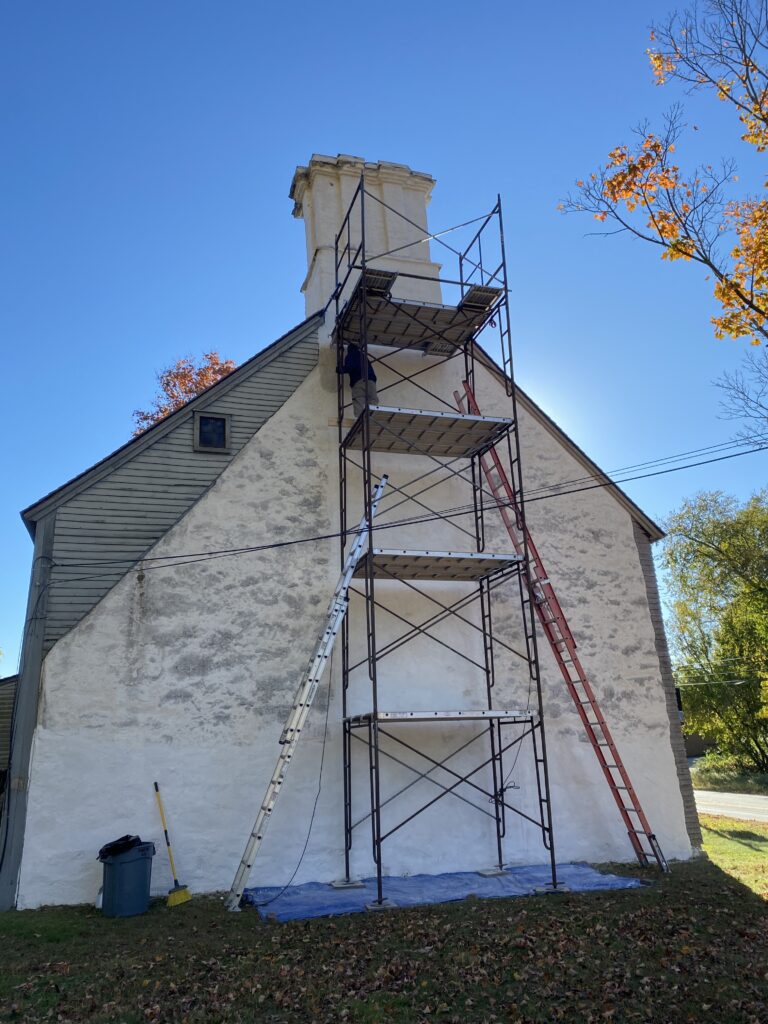
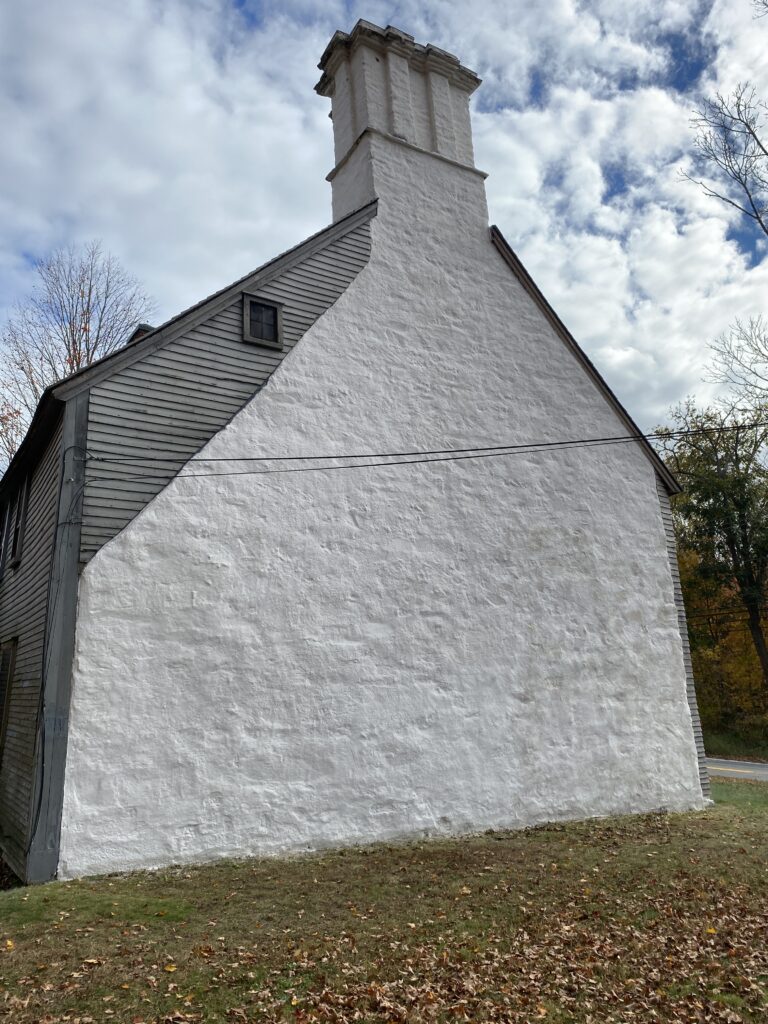
Arnold House in Lincoln, Rhode Island, received two new coats of limewash in 2025 as part of the ongoing care of the building’s stone end. The treatment protects the historic masonry while preserving the appearance of one of Rhode Island’s largest and most intact surviving stone-ender houses.
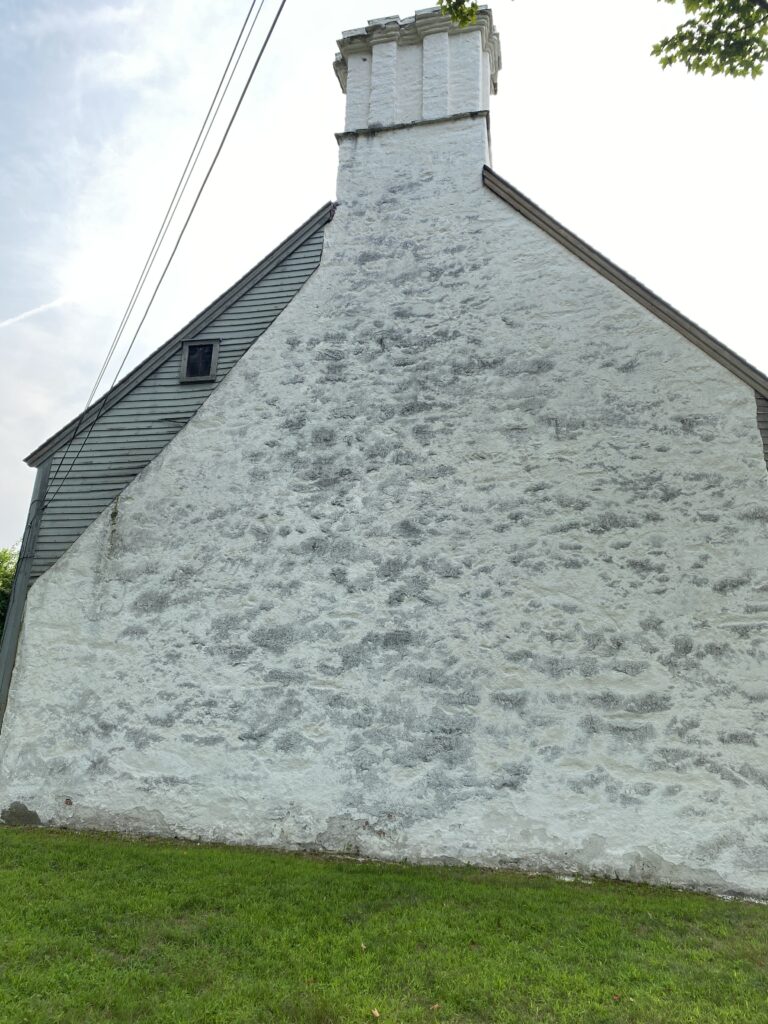
Built in 1693, Arnold House is one of a small number of colonial houses in Rhode Island known as “stone-enders.” Defined by a massive stone chimney that forms an entire end wall, these buildings reflect both the building traditions early colonists brought from England and the materials available locally. The Blackstone Valley and other parts of Rhode Island contained an abundance of fieldstone and limestone deposits. Limestone could be burned in kilns to produce quicklime, which, when mixed with water and sand, became lime mortar. With both stone and mortar readily available, builders could construct stone-enders’ substantial masonry chimney walls using local materials rather than more expensive imported brick. Of the fourteen documented stone-enders in Rhode Island, two are owned by Historic New England: Arnold House and Clemence-Irons House in Johnston.
Protecting exposed stone and mortar is essential to maintaining these historic buildings. The great stone end of this house has a thick coat of a lime-based parge coat to protect the masonry from the weather, over which we apply an additional treatment of limewash. Because limewash is so thin, multiple layers are applied. A decade ago, we applied twelve layers to Arnold House; last year, we added two more. The limewash weathers gradually, and periodic reapplication is an expected part of maintaining the parge coat and the historic masonry beneath.
Made from quicklime and water, limewash forms a thin breathable coating that protects the feature from rain. It also allows moisture within the stone and mortar to escape rather than becoming trapped. This helps reduce damage caused by damp conditions and New England’s freeze-thaw cycles.
Applying limewash requires careful preparation and an understanding of traditional methods and materials. The surface must be cleaned and dampened before the coating is applied in multiple thin layers. As the lime cures, it bonds with the surface below, creating a finish that is durable, breathable, and well suited to historic buildings. Over the coming months and years, the bright white surface will gradually soften as it weathers.
The fresh coat of limewash will help protect Arnold House’s stone end while continuing a long tradition of caring for the building with materials that are compatible with its historic construction. It is a reminder that preserving old buildings is not just about repairing what has worn away, but also about returning to the techniques that have helped them endure for generations. Sometimes the best way to care for a seventeenth-century house is with a seventeenth-century solution.
Mixing limewash produces the dramatic exothermic reaction seen in the video above—and is best left to trained professionals, like those on our Property Care team!
Written By Ben Haavik, Vice President, Property Care and Climate Action and Omri Nassau, Director of Preservation Trades
Sign up to our newsletter for our latest news and events