
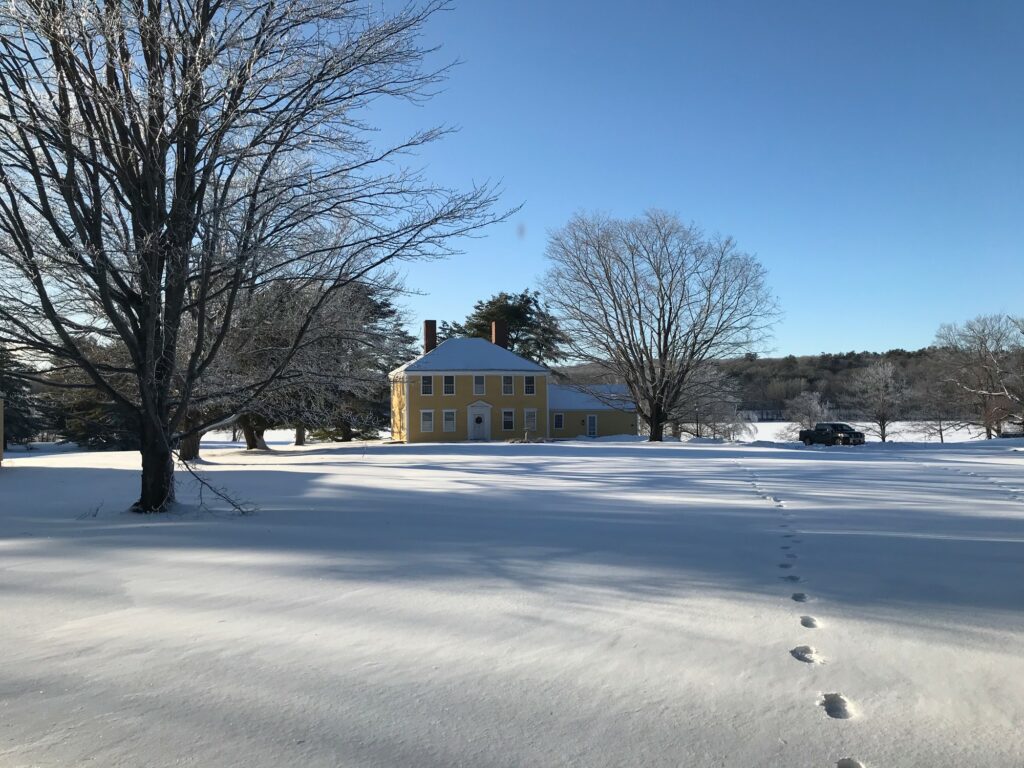

Standing near Bowman House in Dresden, Maine, on a tranquil, sunny day, it’s almost impossible to imagine that the Kennebec River used to be industrial, noisy, and busy. In the nineteenth century, its banks were lined with massive buildings and sailing ships waited along the shore, ready to carry clear, blue blocks of Maine ice to ports around the world.
A little girl growing up in her family’s eighteenth-century farmhouse down the street from Bowman House watched it all: teams of horses straining at sleds, workers shouting and laughing on the ice, and towering wooden buildings filled floor to rafter with frozen cargo. Born in 1890, Jennie Hathorn could see eleven icehouses—owned by the Cedar Grove, Berry, and Lincoln Ice companies—from her home. Managers from the companies came to dinner with her parents and workers often stayed with them during the season. In 1917, Jennie married Harland Everson, who had returned to Maine to work on the ice. The couple raised their family in the old house, and Jennie would one day record the story of the Kennebec ice trade that shaped her childhood.
The business of cutting ice from New England waters and transporting it around the world began in 1806 when twenty-three-year-old Massachusetts entrepreneur Frederic Tudor shipped the first load of ice to Martinique. Boston’s “Ice King” learned by experimentation and error. Ignoring ridicule from his contemporaries, Tudor pioneered the use of sawdust to preserve the ice and built the first icehouses. Beginning in Cambridge, the ice industry spread to every New England state, growing exponentially to serve expanding markets. In 1826—sixty-four years after Jonathan Bowman built his elegant home—the first large icehouse was constructed on the Kennebec River, bringing new prosperity with it. In 1870, the Lincoln Ice Company bought Bowman House and the land around it for a thousand dollars to use as offices and housing for their managers. The company also built an icehouse on the riverfront.
At Bowman House during harvesting season—mid-February through early April—you would have heard men talking, laughing, and grunting, creating blocks in the ice with busting bars, chisels, and saws. Groups of ten to fifteen workers pulled the ice from the river with tow hooks onto heavily loaded sleds. Snorting and nickering pairs of horses pulled the sleds to the base of long, steep elevators. Canal men “fed the chain,” filling the elevator with ice blocks. Steam-powered machinery pulled the ice up the elevator to sawdust-filled rooms at the top of the building. A boss oversaw each team and operation. Inside the building, men carefully placed and stacked the blocks of ice in orderly piles. They filled top-floor rooms first, then each floor gradually down to the bottom. Large bracing boards nailed kept the walls from bowing out against the heavy loads.
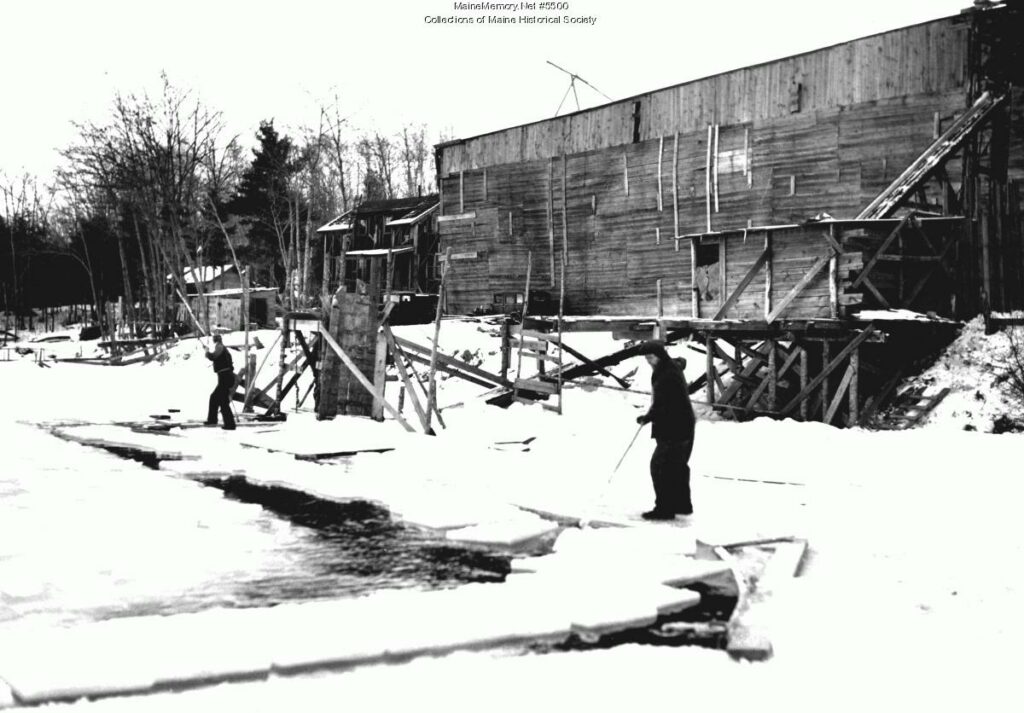
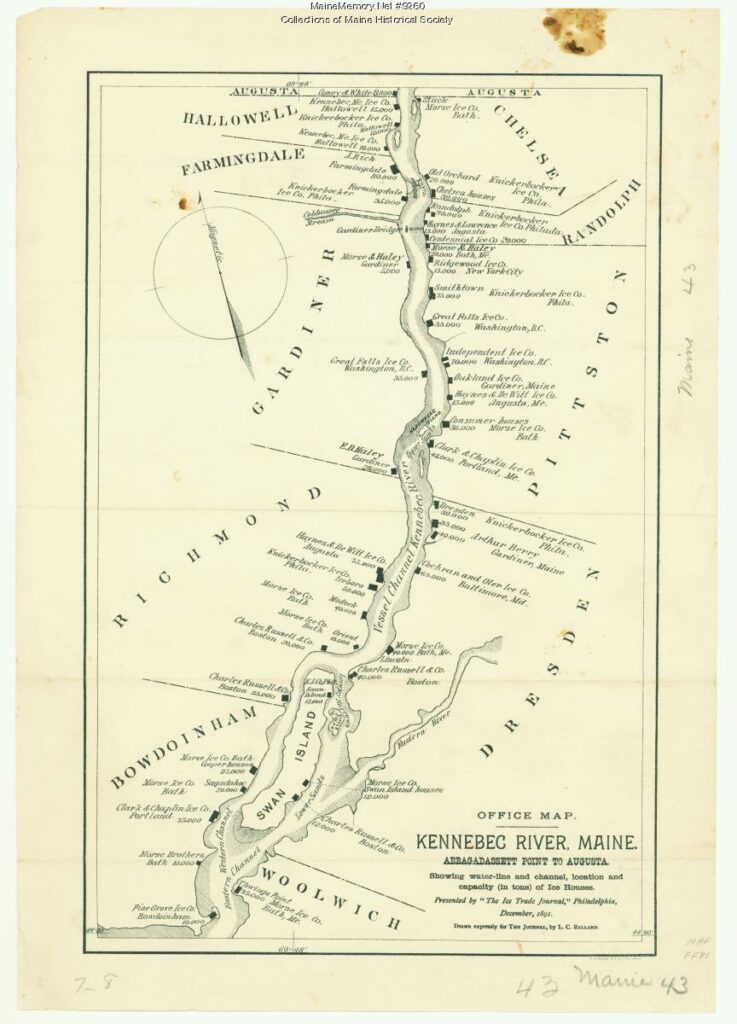
This was the peak of the ice industry. By 1882, two-thirds of Maine’s one-and-a-half-million-ton ice production came from the Kennebec River. Success bred competition. Between 1884 and 1888, Lincoln Ice sold pieces of their business to members of the Morse family, each time for one dollar—or at least that’s what the deeds say. In reality, one company was merging with the others, with one man doing all the buying. In 1891, Charles Wyman Morse of Bath, Maine, bought and consolidated all the ice business in the Northeast, succeeding Frederic Tudor as “Ice King.” In Dresden, locals continued to call the icehouses by their original names.
By 1920, mechanical production and home refrigeration eliminated the market for harvested ice. Yet the story of the Kennebec’s ice trade was not lost, thanks to the dedication of two women: Jennie Everson and Carrie Carlton Cornell. Carrie, whose house was across the road from the Cedar Grove icehouses, photographed it all, saving the images on glass plate negatives. When Jennie’s daughter Eleanor, then in her late teens, began showing interest in Carrie’s photographs, her father built her a model of an icehouse.
Jennie wrote a book using Carrie’s photos along with her own. Published in 1970, Tidewater Ice of the Kennebec River describes in detail the buildings, tools, and processes of harvesting ice. Jennie included names of workers and wrote about the community around them. She told the stories of transient workers who helped with harvesting in winter and locals who got the ice onto ships in summer. Jennie and Eleanor were volunteers in the opening of Pownalborough Courthouse as a museum, where the icehouse model Eleanor’s father built for her has been on display for over fifty years. Eleanor remains the beloved doyenne of Dresden history.
***
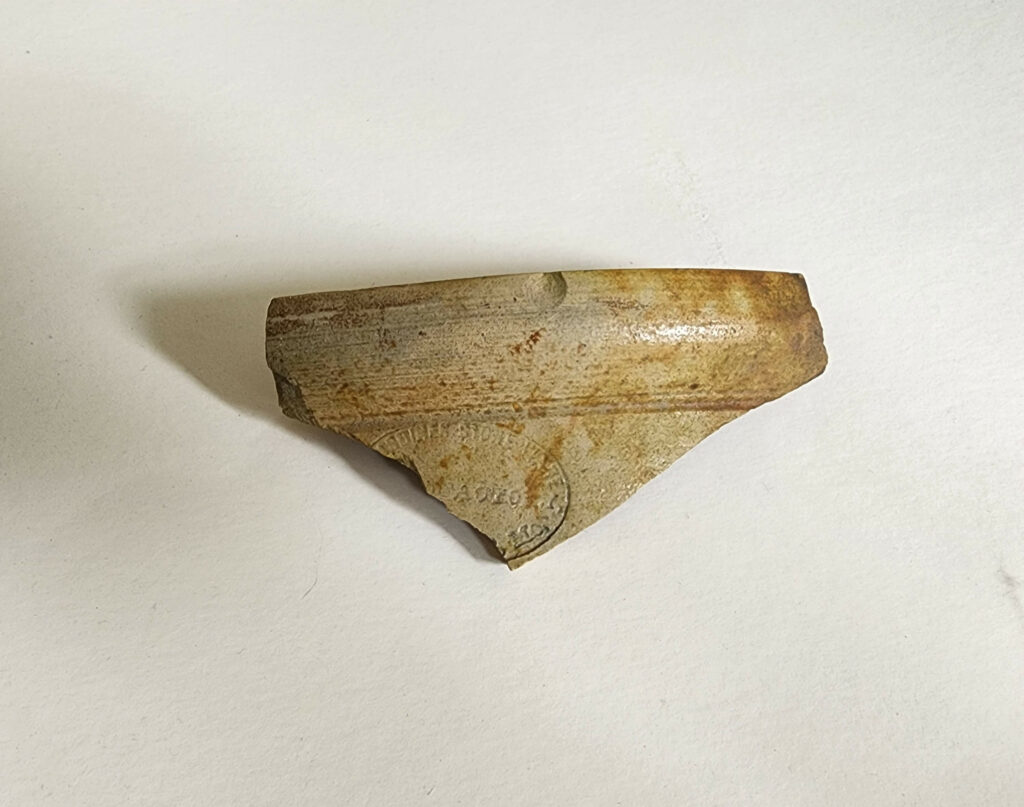
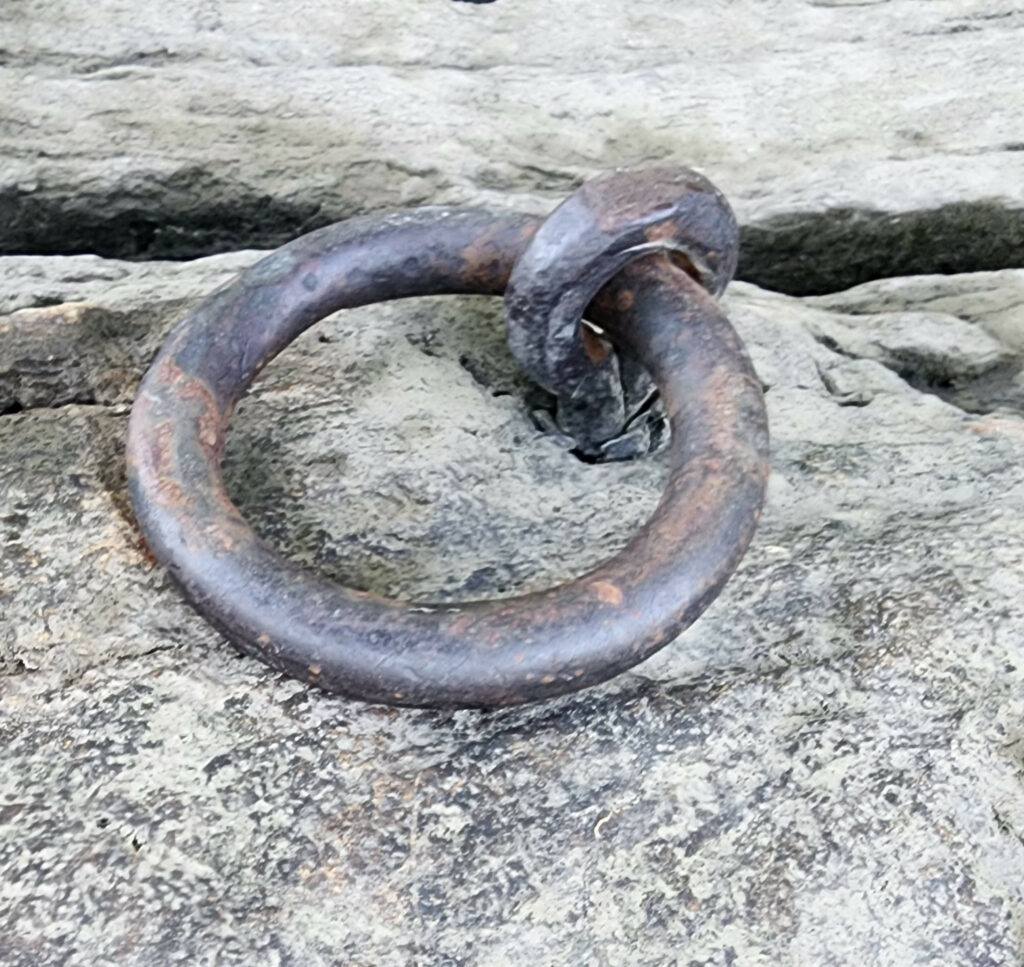
In preparation for this post, I wanted to take a picture of something I saw years ago. It took me two trips, but I finally found it. Walking along the shore at low tide, large timbers of the old wharf are still visible. If you look closely, you can see the remains of a rock-filled wharf pier under the water. The tide was lapping back in when I saw a piece of pottery from a Gardiner Stoneware Manufactory crock (ca. 1876-1893) often used to store pickles on board ships. Finally, I found what I was looking for—the ring in the rock used to tie a ship to the shore, tangible evidence of a past not quite disappeared.
Written by Peggy Konitzky, Midcoast Maine Site Manager
Sign up to our newsletter for our latest news and events