1823-1895, undated
HAV-01-702 (framed lithograph); HAV-01-403-Z-C-616 (folders 1-7; 19)
GUSN-368303
This collection contains architectural materials, the majority depicting buildings designed by Bryant; manuscripts related to his career; and publications related to Bryants building designs, architecture in general, and other miscellaneous topics. Materials are dated between 1823-1895, with a small number of undated materials.
architectural drawings (visual works)
reports
floor plans
elevations (orthographic projections)
transcripts
letters (correspondence)
architectural drawings (visual works)
publications
manuscripts (document genre)
4.76 linear feet (1 framed lithograph, 1 document case, 1 flat file)
An electronic finding aid is available through Historic New Englands Collections Access Portal. A paper finding aid is available in the Library & Archives.
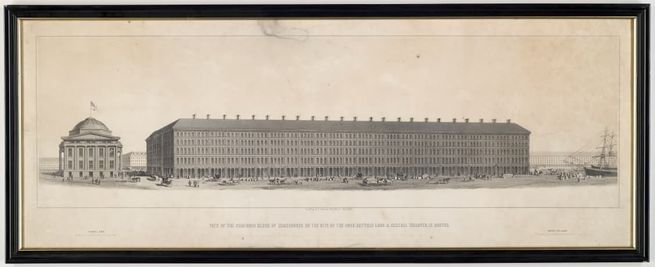
The first item, View of the Proposed Block of Warehouses on the Site of the Dock between Long & Central Wharves, in Boston, was donated by Robert MacKay in 2023. The rest of the collection was donated as an accrual by Robert MacKay in 2024.
AR042
Gridley J. F. Bryant (1816-1899) architectural collection
2023, 2024
AR042
A collection of architectural materials, manuscripts, and publications primarily related to the career of architect Gridley J. F. Bryant.
Gift, Robert MacKay, 2023 and 2024
Boston (Suffolk county, Massachusetts)
Manchester (Hillsborough county, New Hampshire)
Philadelphia (Philadelphia county, Pennsylvania)
Charlestown (Boston, Suffolk county, Massachusetts) [neighborhood]
Norfolk (Norfolk Indep. City, Virginia)
Bryant, Gridley James Fox, 1816-1899 (Architect)
architectural drawings (visual works)
publications
manuscripts (document genre)
Bryant, Gridley James Fox, 1816-1899
Bryant, Gridley, 1789-1867
Baldwin, Loammi, 1780-1838
Mullett, Alfred Bult, 1834-1890
Potter, William A., 1842-1909
Boston City Hospital
Architecture
Architects and builders
The collection is available for research.
Materials were rehoused in acid-free folders.
Some materials were unframed for long-term preservation.
A number of materials, particularly the architectural materials and publications, are fragile. Handle collection with extreme care.
Collection
HAV-01-702 (framed lithograph); HAV-01-403-Z-C-616 (folders 1-7; 19)
Accruals are not expected.
No materials have been removed from this collection.
Materials are entirely in English.
Item identification. Box #. Gridley J. F. Bryant (1816-1899) architectural collection (AR042). Historic New England, Library & Archives.
Jordan Meyerl, Senior Archives Cataloguer, 2025
This finding aid is Second Edition DACS-compliant.
New Jail and Keeper's House, at South Boston, Mass.
Town houses of James M. Beebe & Gardner Brewer House, covering the John Hancock Estate on Beacon Street, Boston, Mass.
City Hall, Boston, Mass.
Architectural Plans, Boston City Hall
Diary of an unidentified architect, Watertown, Mass., 1866
View of the new jail for Suffolk County, in the State of Massachusetts, erected in the City of Boston upon Charles & North Grove Streets
View of the proposed block on the site of the dock between Long and Central Wharves, in Boston
"View of the New Alms House for the City of Boston, in the State of Massachusetts, Erecting on Deer Island in Boston Harbor, 1849."
Set of architectural drawings of the Thomas Wigglesworth House, Manchester, Mass., Feb. 1889
Crowd gathered at city hall for a military parade, Lynn, Mass., May 1919
Exterior view of Horticultural Hall, corner of Tremont Street and Bromfield Street
Gridley James Fox Bryant, often referred to as G. J. F Bryant or Gridley J. F. Bryant, was an influential Boston architect, builder, and industrial engineer. Bryant was born in 1816 to Maria Winship (Fox) Bryant (1794-1877) and Gridley Bryant (1789-1867), civil engineer and founder of the Granite Railway Company, in Scituate, Massachusetts. In 1839, Bryant married Louisa B. Braid (1816-1883). The couple had no children. He died in his townhouse in Boston, Massachusetts on June 8, 1899. Following his death, his wife assembled his books and drawings in his home study and subsequently burned down the house in accordance with the stipulations in his will.
Bryant was heavily influenced by his fathers work in construction engineering and taught himself industrial engineering, construction analysis, and building design. He received no formal architectural training, instead reading extensively on European architectural practices and turning his self-taught skills to architectural design. Bryant was an apprentice to civil engineer Loammi Baldwin, Jr. (1780-1838) and engineer-architect Alexander Parris (1780-1852). In September 1837, he established his own architectural firm, Bryant & Associates, which became one of the most sought after and well-respected firm in New England. He collaborated with numerous architects throughout his career, including Arthur Delevan Gilman (1821-1882), Alexander Rice Etsy (1826-1881), Edward Hale Kendall (1842-1901), and Wilfred E. Mansur (1855-1921). He later opened the firm Bryant & Rogers with Louis Rogers (1838-1905), an architect who previously worked as a draftsman in Bryants office in the 1850s, in 1867.
Throughout his career, Bryant incorporated a number of architectural styles into his work, including Neoclassical, Second Empire, Greek Revival, Gothic Revival, and Victorian. He was also a proponent of the Boston Granite Style, an architectural style which prioritized the use of granite, a readily available local stone, in construction. Bryant designed commercial, residential, academic, ecclesiastic, and government buildings, among others. Some of his more well-known projects include building or remodeling of numerous state capitols, including Massachusetts State House; Saint Peter and Paul Church in South Boston; State Street Block in Bostons Financial District; Ballou Hall on the campus of Tufts University; The Almshouse in Cambridge, Massachusetts; Salem station in Salem, Massachusetts; the Charles Street Jail in Boston, Massachusetts; the John Tucker Daland House in Salem, Massachusetts; and Boston City Hospital.
Construction of the Massachusetts State House. (n.d.). Secretary of the Commonwealth of Massachusetts. Retrieved May 14, 2025, from
Reed, R. (2007). Building Victorian Boston: The Architecture of Gridley J. F. Bryant. University of Massachusetts Press.
The collection is arranged in 3 series:
Series I. Architectural materials, date
Series II. Manuscripts, date
Series III. Publications, date
Historic New England is committed to implementing reparative language description for existing collections and creating respectful and inclusive language description for new collections. If you encounter language in Historic England's Collections Access Portal that is harmful or offensive, or you find materials that would benefit from a content warning, please contact [email protected].
Sign up to our newsletter for our latest news and events

 Loading...