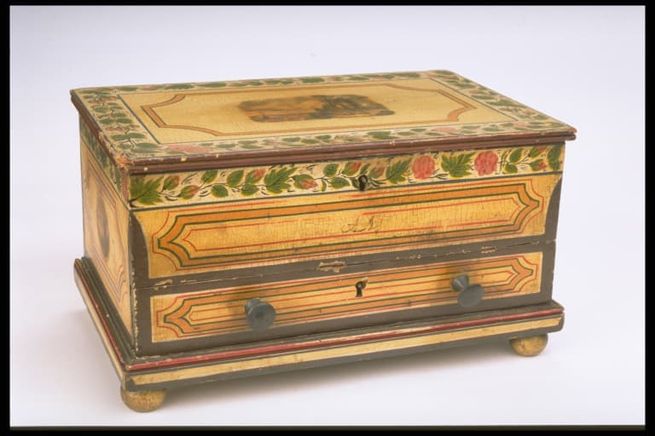
Rectangular form with hinged lid, case with one long drawer fitted with four compartments; painted yellow and decorated with freehand border of rose vines, enclosing red, blue, bold shaped reserves containing decals at top and sides, decal of Indian on lid, decal of East view of Faneuil Hall Market, Boston on underside of lid; box and drawer lined with marbleized paper.
sewing boxes
needlework (visual works)
painting (coating)
wood (plant material)
Wood
Painted
Box
Box, Needlework
Beyond this boxs use as a sewing notion, and its New England origins, little is known about this object. Sewing boxes such as these were primarily used by women during the nineteenth century, when sewing and needle arts were common pastimes for white, middle-class women and means of making money for working class women during the eighteenth and nineteenth centuries. They likely would have displayed and used their sewing boxes in areas of leisure in their home. This led to a demand for boxes that were both functional and decorative.
Over the course of the nineteenth century the Myth of the Vanishing Indian developed as a part of the view that westward expansion by white settlers across North America was an inevitable part of progress and that Indigenous people were part of the past. In reality they were displaced from their ancestral lands through forced migration, war, illegal seizures of land, and illegitimate treaty negotiations. The decal on the top of the lid shows the Indigenous person in the undeveloped wilderness with the buildings and city just down the hill, perpetuating a popular decorative tradition of depicting the Vanishing Indian stereotype on domestic goods.
Furthermore, when that decal is juxtaposed with the painting on the underside of the lid this message made is clearer. The painting of Faneuil Hall, a marketplace and meeting house, was the pinnacle of Bostons society. It was where discussions, meetings, lectures, and debates took place. It was a congressional space, one that allowed for what constituted democracy in the eighteenth and nineteenth centuries, meaning primarily wealthy and middle-class white men. Notably, Faneuil Hall was paid for by Peter Faneuil who made his money through the Atlantic Slave Trade. Both images assert that democracy and humanity were only extended to a certain class of people and when viewed together compound this.
This box was purchased by Bertram K. and Nina Fletcher Little in 1984. Much of their collection focuses on capturing various mediums and themes found throughout American folk art, and it is possible that the Littles thought of this as little more than just another example of American art and material culture. However, it is also possible that they considered how this imagery was part of a broader trend in American art and wanted to create a dialogue between it and how the white subjects were treated in other works throughout the house.
Used At Faneuil Hall (Boston, Mass.),
Unknown
6 x 10 1/4 x 6 3/4 (HxWxD) (inches)
Gift of Bertram K. and Nina Fletcher Little
1991.276
Massachusetts (United States)
Historic New England is committed to implementing reparative language description for existing collections and creating respectful and inclusive language description for new collections. If you encounter language in Historic England's Collections Access Portal that is harmful or offensive, or you find materials that would benefit from a content warning, please contact [email protected].
Sign up to our newsletter for our latest news and events

 Loading...