
New England Home Life in the COVID-19 Pandemic
Home in the midst of COVID-19 can also mean school, office, entertainment center, and hospice. The crisis and its financial impact may result in the loss of home for many. We want to know how your home life has changed because of the pandemic.
We want to hear your stories about home life and COVID-19. We hope that by selecting from the options below you will contribute your insights and items. These will help Historic New England tell the story of this unprecedented time for generations to come.
#DocumentingCOVID
Are you keeping a COVID-19 diary/journal? We would like to hear from you. Here are some questions that you might want to consider answering as you record your experiences.
1. How are you coping with stress during this difficult period, including emotional, physical, interpersonal, and financial?
2. Have you lost a family member or friend? Have you or any family member or friend contracted the virus?
3. If you could pick one item—object, photograph, journal—to represent your experience in this crisis, what would it be?
4. Do you view your home or the idea of home differently now than you did before lock-down?
5. Are you doing things regularly now in isolation that you did not have time for before the crisis?
6. Have you lost your income or shelter because of this crisis?
7. Have you participated in any activities remotely and did you feel differently about your participation because it was via technology, for example, religious services, family events, sports, other?
The following images appear with the donors’ original captions, edited slightly for length. We will continue to update this page as new contributions are submitted.
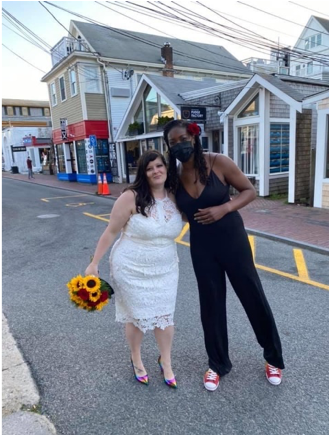
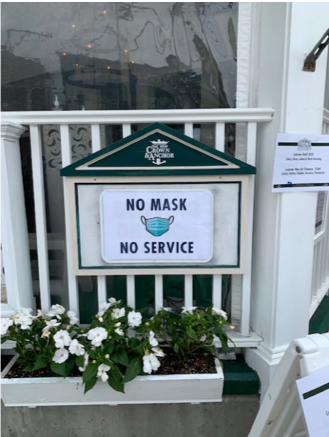
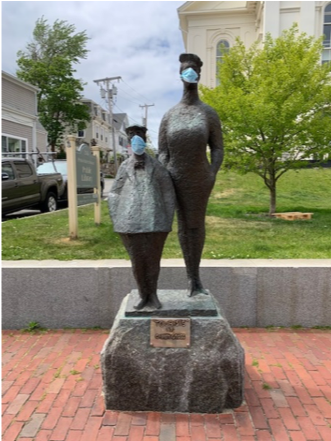
Contributed by Stephen Desroches
“All of these photos were taken in Provincetown, Mass., a tiny town on the end of Cape Cod…All the signs and imagery reflect how isolating this pandemic has been for Provincetown. Come this time of year Provincetown should already be full of people from all over the world either here to work for the summer season, paint, or just relax. While home to a small, hearty population of about 3,000 people who are the heart and soul of the town, the seasonal influx of people is vital to the town’s economy and unique culture. The pandemic continues to leave a heavy fog of anxiety and uncertainty as there is no clear path forward as to how safely return to anything like it normally is. Clearly the summer of 2020 is already going to be extremely different, if not a complete and total washout.”
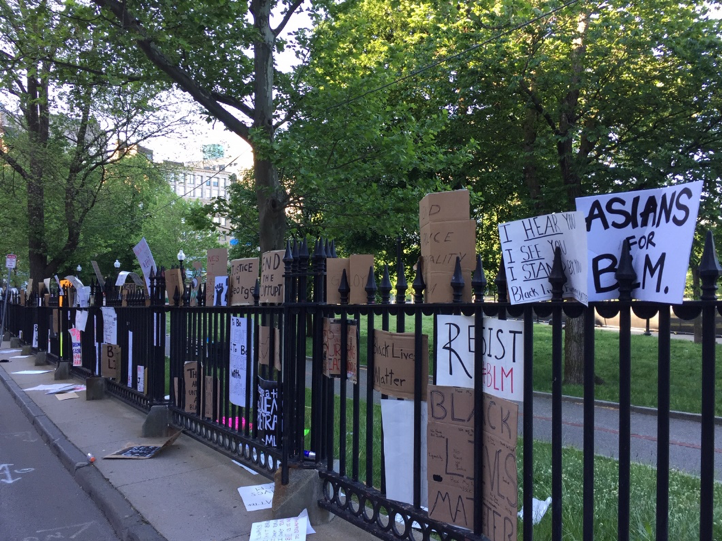
Contributed by Elliot Isen (a Historic New England staff member)
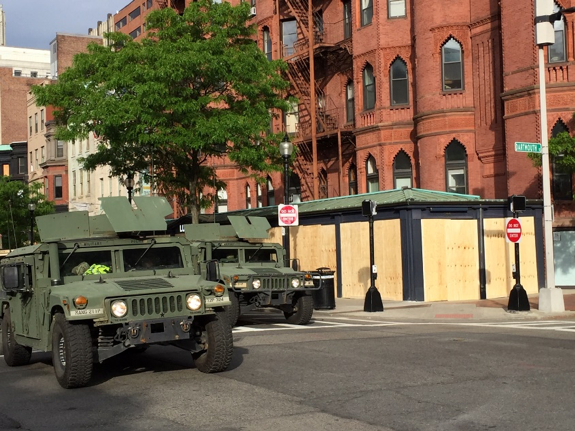
Left: “I wanted to share photos I took during an early morning walk through parts of downtown Boston on June 1, following protests in the city in the evening of May 31 and early morning of June 1 against the death of George Floyd… The fact that these protests occurred during the time of COVID-19 with widespread knowledge of the risk of gathering in large groups, makes the sentiment behind the protests all the more powerful.”
Right: “More pictures of life in downtown Boston during the week of protests against George Floyd’s death and racism in our country, taken on June 2, 2020. I want future generations to know more about this time in our history.”
Contributed by Ray Boas
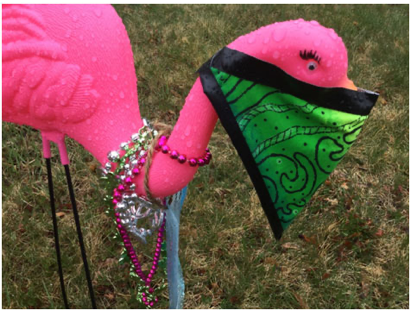
“To spread hope and smiles in Walpole, N.H., Flamingos began appearing around the village — possibly following a story in the April issue of The Walpole Clarion…things caught hold, and in May over 100 Flamingo sightings were documented, and shared on this page. It has helped, and whoever made it happen brought smiles during these times.”
Contributed by Jane Hennedy (a Historic New England staff member)
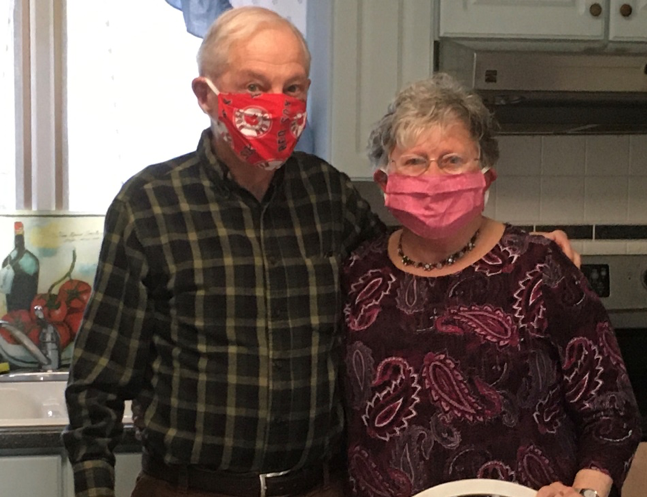
“John and Marie Hennedy, my parents in their kitchen…in Warwick, R.I. were among the thousands of precious people who we were all protecting by staying at home as much as possible. As their deputized grocery shopper I got to visit every two weeks or so, carefully staying at least six feet away and wearing my cloth mask. In April of 2020, when R.I. was still in full lockdown, they posed for me in their custom-made cloth masks that may hide their faces but reveal something about their personalities with Mom’s colorful one and Dad’s beloved Red Sox one.”
Contributed by Stephen Desroches
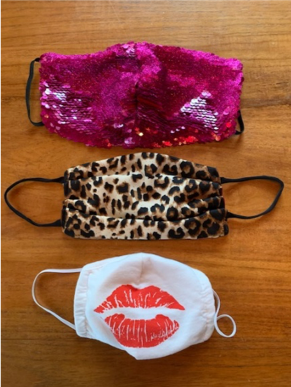
“Provincetown is long home to a large LGBT population and as such the face masks here often have a certain flair. Many of the people who made masks for the community are drag queens (out of work as their shows are cancelled). The leopard print mask was made by a local drag queen named Bang. The lip print and pink sequin masks were…sold and bought locally…”
The human spirit is a funny thing. When tested in extreme circumstances, one will either rise to overcome the struggle or slowly fall victim into a crushing pit of devastation. Prior experiences will enter into the equation, along with how big or small one’s support system is. Some might consider the strength of which one succeeds, or one might even say thrives or withers away, a consequence of nature or nurture. At the end of February 2020, I was mildly aware of a virus that had hit Wahun, China hard. There were visuals on social media news outlets of people walking around with masks on, news of people being ordered to stay indoors and images of people overtaking the streets, dressed in PPE’s, masks and hosing down the streets with disinfectant. Little did I know just how serious those warnings were. Little did I know just how significant those reports would become in the United States.In my life, I have faced what I consider to be traumas that have affected the way I interact with the world. I learned in my early 20’s just how important it was to hold your loved ones close. Having lost my older brother when I was 23, I realized that nothing is guaranteed. Life can be stolen from you without prior warning. After the loss of my first brother, life became a series of grabbing on to one precious life after another without the ability to let go. When I was 36, my younger and only living sibling died. He was 32. I was left an only child, a piece of dune grass, swaying in the wind, rooted tightly to where I was by my strong upbringing and the parents and family that loved me. Through both of those unexpected tragedies, I was broken. Through perseverance, I willed myself to carry on. The responsibility of taking care of my kids, my husband and my parents pulled me through. I slowly healed not to the point of being whole again, but to the point of being able to function. Growing my kids was my primary focus in life. I made them the center of my world. As they grew up and became more independent, I was aware that my role in their lives was changing and that I was going to have to redefine myself. The thought of getting a job and meeting new people was as exhilarating as it was intimidating. But I was preparing for the challenge. Then in 2019, when I was 46 years old, my father underwent unexpected open-heart surgery to replace a valve. As the only child left, I took the responsibility of caring for my father, alongside my mother. I was at his bedside 24/7 to advocate for him and to make sure he had everything he needed, both physically and emotionally. I was honored to be able to give back to a parent that had cared for me, unconditionally, for so long. That summer and well into the fall proved to be another very challenging time for me. My dad suffered from Postperfusion Syndrome, which was basically the same as if he had dementia, complete with cognitive decline, episodes of sundowning and memory loss. After many many weeks of feeling a sense of loss for the father that I knew, he gradually began to gain his faculties back. Through all of the struggles we faced together, I grew stronger as a person. The lesson of not taking family for granted was once again, branded in my heart and soul.
It is now 2020. As the news of the Coronavirus spread in the United States and started to become very serious, things have changed considerably for my family. The girls are struggling with the new reality, the new life of not being able to see their friends and family in person and having to deal with remote relationships. Michael is dealing with working from home every day and not having the freedom to come and go as he pleases. That perception of freedom has proven to be critical in the way we view life. Through March and April, my reality of being isolated and having limited mobility was sufficient for me. There were enough projects for me to do around the house, including sewing masks, painting, housework and reading. We were fortunate in that I didn’t have to work and we could have people do our shopping, putting themselves in danger, for us. It was only over the last few weeks that I have started to feel the effect the virus is having on my well-being. I find myself feeling chest pains from anxiety. My hands often shake while I’m working on my projects. I’ve had to take to meditation to help with some of the anxiety. I’ve found that I’m not motivated to do any projects around the house. I have a hard time being motivated to walk anymore, something that I’ve always loved. I’m not even moved to sit outside in the sun any more, something that has always given me sustenance. I’m sleeping much more and all I want to do is lay in bed. I believe that my depression is getting worse due to lack of interaction with other people but it is a perpetual cycle. The more I stay in, the more comfortable I am alone. And it’s difficult to put a wrench in that cycle when there is no hope that things will get better. There is no cure for the virus. Projections indicate that it will be at least the beginning of 2021 before a vaccine is released, and that’s optimistic. There are no treatments that I know to be working. There are stories all the time of young, healthy people getting the virus and hitting them hard. And there is no plan for how the United States will successfully move past this. Almost 100,000 deaths and counting and 1.6 million reported cases of the virus in the country, alone. I still hold on to hope that eventually things will get better and that we will get back to a sense of normal. I will be able to go outside and walk without worrying about whether or not I will become infected with the virus and spread it to my family. I will be able to hug my mom again. I will be able to laugh at my dad’s jokes to his face again. My kids will have their normal back again. In the meantime, I will try to focus on the good: the way my dog brings me her ball so I can play with her; the sound of the kids in the neighborhood laughing and playing; families outside spending time with each other; the videos and texts that my niece sends me of her baby; my daughter including me in her video games and preparation for college, my husband’s encouraging words; Facetime calls with my mom and dad. And I will continue to hold on to hope.
Sign up to our newsletter for our latest news and events