
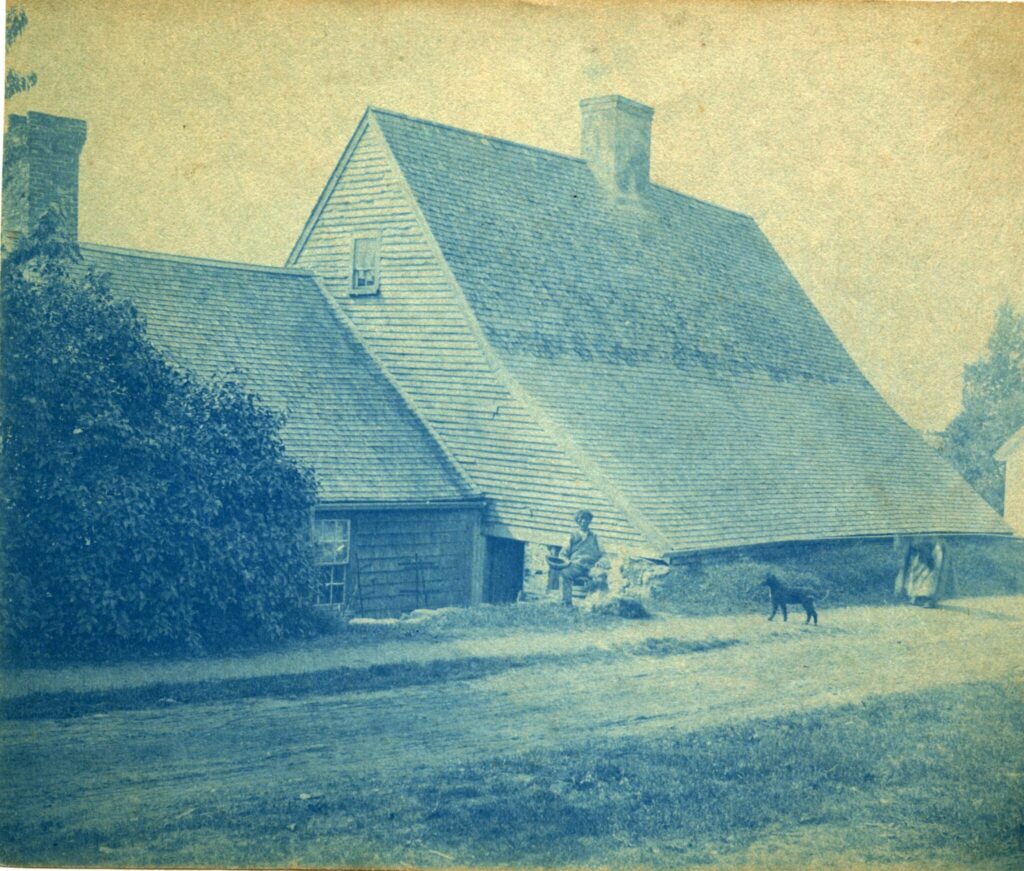
Isabelle Tilley was born enslaved, though her date and place of birth are uncertain. Some sources suggest she traveled north from Richmond, Virginia, with her enslaver’s son when she was around twelve; according to Tilley family narratives, she reached freedom on the Underground Railroad. Promised an education, Isabelle instead was forced to wash clothes for local white families and sleep in barns until, at about fourteen, she acquired a small shack. While much of Isabelle’s early life remains shrouded in mystery, we know she spent over eighty years working for the Jackson family in Portsmouth, New Hampshire, as a caregiver, cook, and washerwoman. In 1870, Isabelle had her first son, Clarence, born from a relationship with a White man, named George Fisher. Later that decade, she married Jacob Tilley, who adopted Clarence. Together, they had three daughters and one son, and adopted a third son. Census records contain the names of four of Isabelle and Jacob’s children—Clarence, Charles, Claretha, and Huston Allen. After Historic New England acquired Jackson House in 1924, Isabelle continued to live in a small house next door, renting it for $1 a week until her death in 1937.
Read more in the magazine and on the blog.

When Charles Bowie arrived in Boston in the early 1880s, he sought a better future, leaving his Maryland family behind. Likely born into a family enslaved by the prominent Bowie family, he grew up near their plantations, where agricultural shifts led to a mixed workforce of enslaved and paid laborers. By 1882, Charles worked at Boston’s Hotel Berwick and later became an “inside man” for wealthy families, including clothier Charles N. Carter and hemp merchant Richard Harding Weld. In 1888, he advertised for a new position, likely leading to employment with widow Mary Hemenway. He remained at her Beacon Hill home through her death in 1894, later managing the household under her son-in-law, W.E.C. Eustis. Charles remained with the Eustis family until his death in 1928, but his legacy extended beyond service. As a founder of the Ward 9 Club, he played a key role in early Black political organizing in New England, challenging racial barriers and leaving a lasting mark on Boston’s history.
Read more in the magazine.
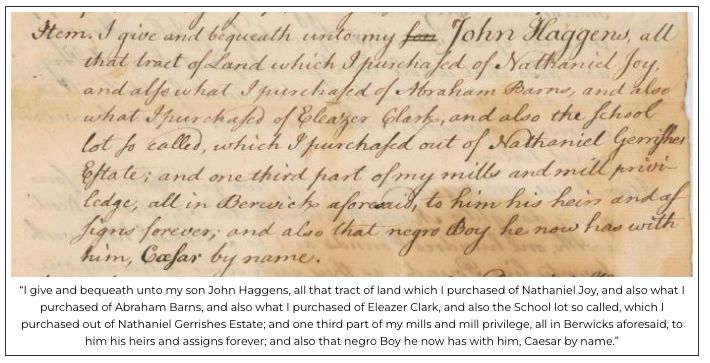
Caesar, an enslaved man in the late 1700s, labored at what is now the Sarah Orne Jewett House in South Berwick, Maine. Mentioned in Tilly Haggens’s 1777 will, he was bequeathed to Haggens’s son, and census records from 1790 and 1800 suggest he may have remained there into the nineteenth century. Jewett’s novel The Tory Lover references a character named Caesar, possibly inspired by the historical figure. She describes him as a “Guinea prince,” echoing real cases of West African royalty captured in the slave trade.Jewett did not explicitly acknowledge when her fiction was informed by history, underscoring gaps in recorded accounts of slavery in New England. However, research supports the idea that Caesar—or another enslaved man in the Haggens household—may have been born in Guinea, connecting Jewett’s fiction to real history.
Read more in the Winter 2024 issue of Historic New England magazine.
Sign up to our newsletter for our latest news and events