
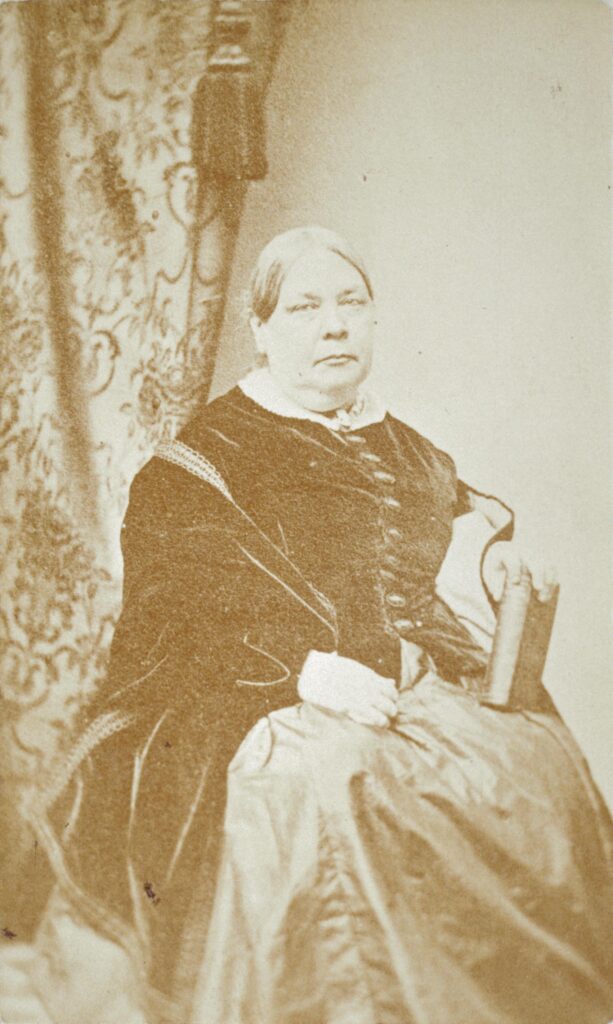
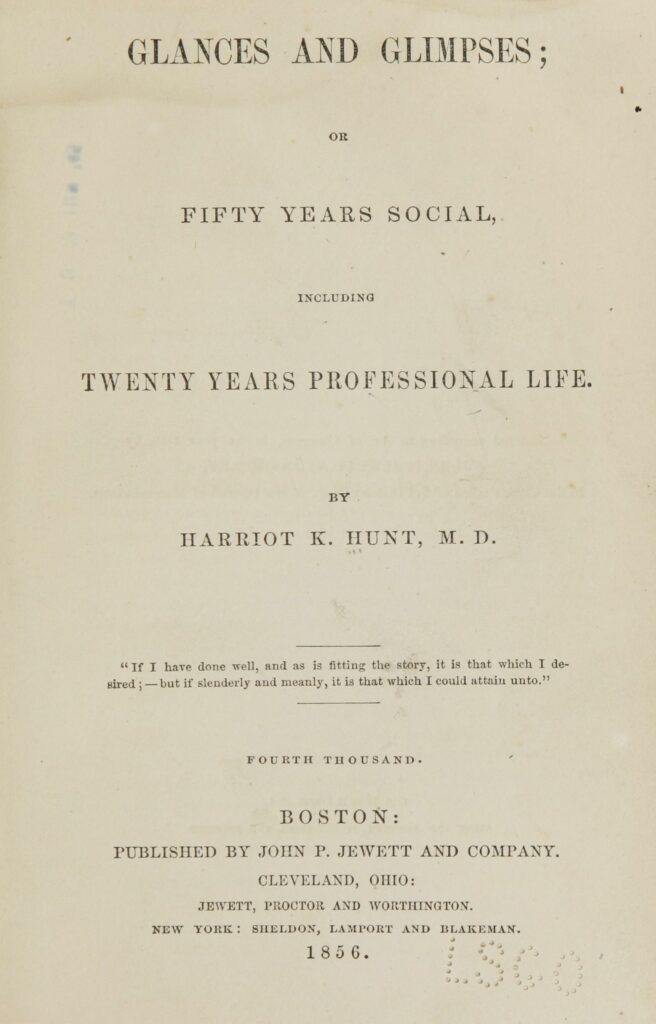
On June 27, 1860, Dr. Harriot Kezia Hunt threw an elaborate party in her Boston home to celebrate her silver wedding anniversary. However, she was an unmarried woman with no future plans of matrimony. Who was her lucky partner of twenty-five years? The Boston Liberator described the happy pair as Miss Harriot K. Hunt and Harriot K. Hunt, MD. Among friends, family, and admirers, Harriot reaffirmed her vows to her career as a medical practitioner. She had dedicated herself to medicine, not marriage.
Harriot was born in Boston in 1805, and with her sister, Sarah, became a teacher in 1827. The Hunt sisters crossed paths with one of Historic New England’s properties a few years later when Sarah experienced a health crisis that doctors were unable to cure. Bloodletting and leeches, standard practices to treat disease at the time, had failed. Harriot later wrote in her autobiography that the process was awful for Sarah: “I marveled—all this agony—all these remedies—and no benefit!”
At their wits’ end, the sisters turned to physicians Richard and Elizabeth Mott, tenants at what is now Historic New England’s Otis House in Beacon Hill. The Motts were alternative medical practitioners who offered advice and patented herbal steam baths in the residence. Despite their hesitation at seeking help from people not formally recognized by the medical community, the sisters approached the Motts in June 1833. This was a life-changing experience for both Harriot and Sarah, inspiring them to consider medicine as a calling.
The Motts treated Sarah differently than the other doctors the sisters had previously seen. They diagnosed her with consumption and developed a treatment plan that finally worked. After three and a half years of illness, Sarah was finally healthy enough to go on walks and return to church, and Harriot was inspired by this success.
In 1834, the sisters moved to Otis House with their mother to study under the Motts. Harriot and Sarah then opened their own practice and began offering medical services to women and children. Harriot developed a method of treatment that she called “heart-histories.” She had lengthy conversations with her patients about their personal lives, stressors, and social circumstances in addition to their physical illnesses. Most importantly, she was a sympathetic listener.
Harriot was establishing a successful medical practice, but she remained an unlicensed physician. Her training consisted of practical experience under the Motts and extensive personal studying that extended into nighttime reading sessions with Sarah once they opened their practice. Early in their careers, Harriot and Sarah offered herbal remedies similar to those of the Motts. Her medical practice and beliefs evolved over time as she became immersed in different schools of thought, including phrenology, physiology, and spiritually-driven care. Her views changed to the point that she disavowed her first mentor, Elizabeth Mott, for being too reliant on herbalist remedies.
Harriot’s practice reflected her nontraditional educational path. When she began her career, no medical schools in the United States admitted women. In 1847, Harriot became the first woman to apply to Harvard Medical School—and the first to be rejected. After applying again in 1850, the faculty voted to allow her to attend lectures, coinciding with the first admissions of Black men to Harvard Medical School: Daniel Laing Jr., Isaac Humphrey Snowden, and Martin Robison Delany.
Harvard’s medical students were outraged at the prospect of a woman attending lectures. They argued that she would “sacrifice her modesty” by learning about the human body, and their protests created a hostile environment. Harriot ultimately did not attend the lectures, and the three Black students were dismissed shortly after the term began. Although denied full participation, all four pursued medical education elsewhere and achieved professional success.
As a young woman at Otis House two decades prior, Harriot lived only a few blocks away from Harvard’s first teaching institution, Massachusetts General Hospital. She would have watched the campus grow and expand. Yet, she would never have the opportunity to learn there. Harriot, Laing, Snowden, and Delany all had to find schooling and accreditation elsewhere, which each did successfully through different routes.
In the 1850s, Harriot moved into public speaking to advocate for women’s rights, particularly the right of women to learn and practice medicine. She also famously refused to pay taxes to protest the inability of women to vote. In 1853, after eighteen years as a medical practitioner, Harriot was finally awarded an honorary doctorate by the Female Medical College of Philadelphia. She proudly placed “MD” after her name in her silver wedding announcement two years later. A friend credited as Miss Foster summed up Harriot’s success in a poem read for the celebration:
“Though friends opposed, and Harvard’s halls
Swung their gates upon her, With her ‘M. D.’ no longer she
Needs look to them for honor.”
Written by Rebecca Lo Presti. Lo Presti is a PhD student at the University of Massachusetts Amherst and interned with Historic New England’s Study Center in 2025.
Beginning in summer 2026, Otis House will offer walking tours exploring Beacon Hill’s nineteenth-century medical history. Dates and times will be announced this spring; visit Historic New England’s Events Calendar for updates and registration information.
Sign up to our newsletter for our latest news and events